Context fragments
Repositories, delivery files, standards, and agent sessions each hold only part of the project story.
Engineering Case Study
Controlled Project Standards and Delivery
A local control plane that discovers project context, manages evolving standards, and turns proposed repository changes into reviewed, verifiable delivery.
Designed and built by Irving M. as an evolving engineering system. This case study documents implemented behavior; the product overview lives on its own site.
01
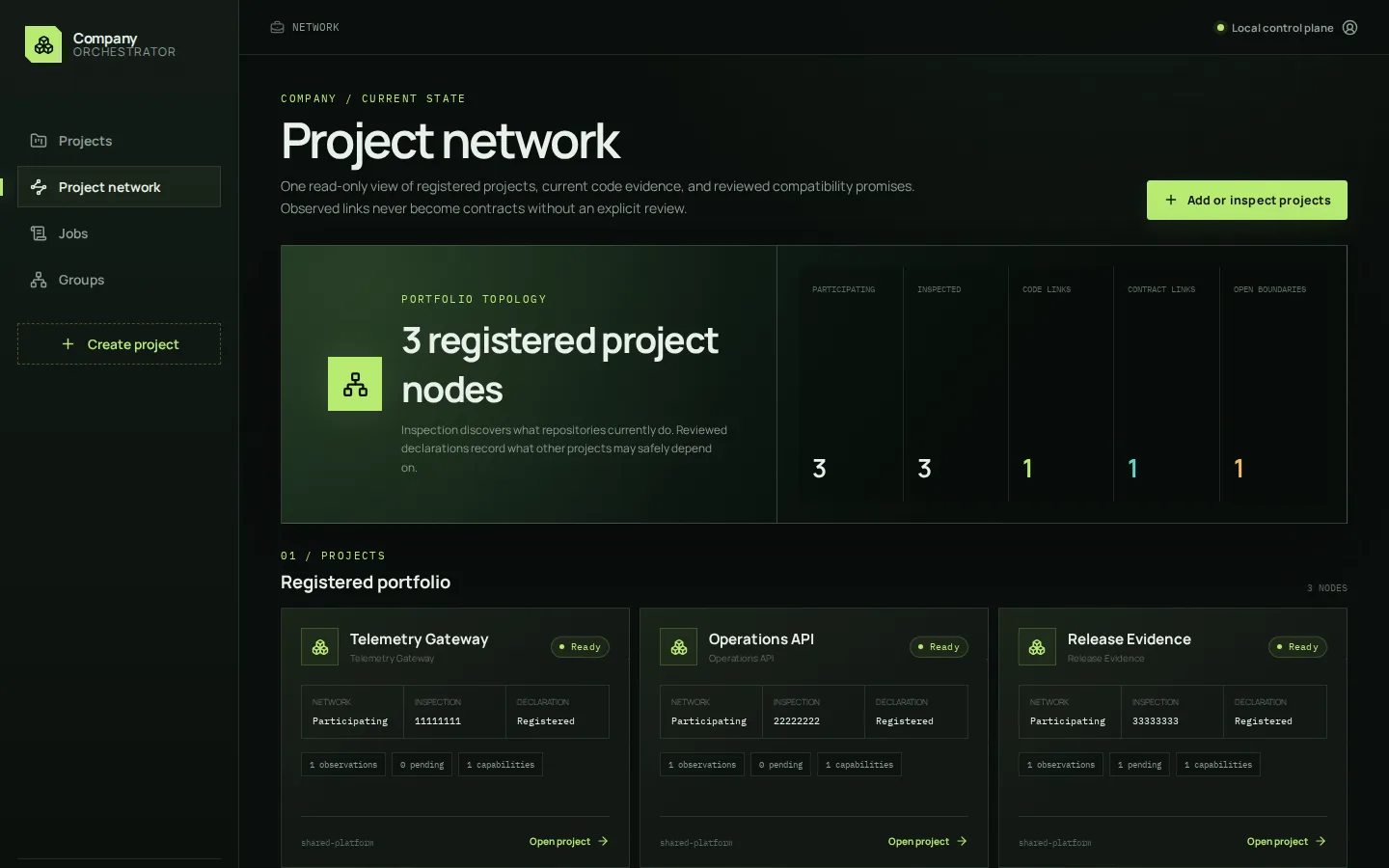
The Project Network makes discovered dependencies and reviewed contracts inspectable in the same interface used to understand project state.
02
Project knowledge fragments across repositories, tools, and agent sessions while shared standards continue to evolve. Existing projects need a controlled way to understand what they run, compare it with current capabilities, and adopt changes without giving automation unrestricted write access.
Repositories, delivery files, standards, and agent sessions each hold only part of the project story.
A capability adopted today still needs a controlled upgrade path when its contract changes tomorrow.
Repository changes are useful only when inspection, approval, delivery, and evidence remain independently reviewable.
03
Each stage establishes a reviewable boundary between understanding a repository and changing what it delivers.
Add a new workspace or an existing repository inside an approved local root.
Read project structure, declarations, pipelines, and exact HTTP or MQTT evidence without writing.
Create a versioned, digest-protected change plan and unified diff from the inspected state.
Require an explicit human decision against a stable review artifact before mutation begins.
Materialize only reviewed paths in an orchestrator-owned checkout and publish a review branch.
Bind policy, merge, pipeline, and deployment evidence to the exact commit that was delivered.
04
Built one local portal for new-project bootstrap and existing-project adoption. Read-only inspection records repository evidence and cross-project relationships; versioned profiles produce immutable proposals; isolated Git candidates, explicit approval, Azure DevOps policy checks, guarded merge, and exact-commit verification keep every mutation reviewable.
Guided setup, project inspection, network context, proposals, review state, and delivery evidence.
Authenticated local API delegating state transitions and transaction boundaries to application services.
Background jobs, leases, immutable artifacts, SQLAlchemy models, Alembic migrations, and SQLite persistence.
Managed checkouts, review branches, PR policy checks, guarded merge, and exact-commit pipeline verification.
Project identity, dependencies, inspection evidence, and path impact for trusted local coding agents.
05
Repository paths and credentials stay behind a loopback-only portal and trusted local worker account.
Inspection creates evidence and immutable snapshots without modifying the registered checkout.
Reviewed output is materialized in orchestrator-owned checkouts instead of switching or dirtying user repositories.
Approval refers to digest-protected operations and diffs so later state cannot silently change the decision.
The PR head and blocking policy evidence are refreshed before merge, with policy bypass explicitly disabled.
Pipeline and artifact verification accept only the target branch and exact merge commit.
06
07
The Company Orchestrator repository is private. This case study presents the implemented architecture and product evidence without exposing source control.